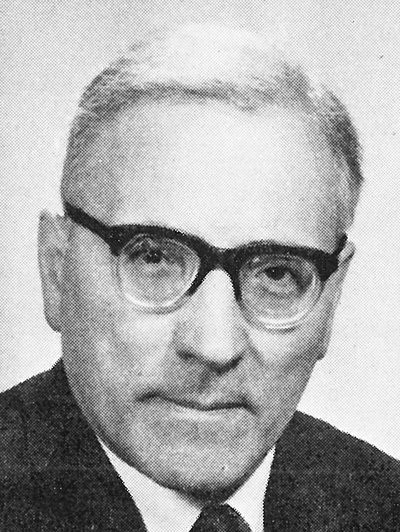
Helmers Pavasars
1903–1998
Organist, composer, violinist, choir conductor, teacher
Helmers Pavasars was born on 19 May 1903 in Lejasciems, Valmiera County (now – Gulbene District), into a pastor’s family. When Helmers was three years old, his family moved to Valmiera where he lived until the age of 18. As a child, he studied violin with Jekabs Medins (Jēkabs Mediņš), and later improved his skills and studied piano at the Valmiera Music School. In 1919, he joined the Schoolchild Company in the War of Independence. After graduating from Valmiera Secondary School, he moved to Riga in 1921 and entered the Latvian Conservatoire where he studied special theory and composition with J. Vitols, graduating in 1928 with a degree of free artist. Two years later, in 1930, he graduated again, this time in violin with Adolfs Mecs (Ādolfs Mecs) but did not pursue a career as a violinist. In 1928, his first workplace was the 26th Riga City Primary School where he taught violin and piano. A year later he became organist at Riga St. John Church and began to direct the church choir.
In autumn 1931 he moved to Valmiera where he was an organist and violin teacher at music school. At the beginning of 1932, he began conducting the Valmiera Latvian Society Choir, and in the autumn he also took up a teaching post at Cesis Music School and continued travelling to Riga once a week to study with J. Vitols in his composition class. It was during this time that his first composition, a string quartet, was written. The workload, however, proved to be too much. In the middle of 1932, Pavasars contracted tuberculosis and was treated for a year in a sanatorium in Turaida. After recovering, he returned to Cesis Music School where he taught violin, music theory and led a small symphony orchestra he had founded. In 1934, he was appointed director of Cesis Music School. In 1938, the Riga Teachers’ Institute moved to Cesis, where Pavasars also taught violin and conducted orchestras, and taught in the evenings at the People’s Conservatoire (in 1937, on the initiative of A. Kalnins (A. Kalniņš), the Cēsis Music School was renamed the People’s Conservatoire). Only late evening hours were left for composing. His songs were sung by the largest choirs, singers chose solo songs for their concerts, and his name was often heard on radio programmes.
On 8 January 1938, Pavasars married Daina Karklina (Daina Kārkliņa), a piano teacher who had started working at Cesis People’s Conservatoire a few months earlier. In 1940, when the Soviet authorities came to power, Pavasars was invited to work at the Latvian Conservatory as a lecturer in compulsory theory classes. In Riga, Pavasars was somewhat independent, his music was still allowed to be played. In 1942, he managed to write eight pieces for violin and piano but all of the 1,000 copies printed in the publishing house were burned when the Germans retreated.
As the situation became more tense, Pavasars and his family left Latvia in 1944. He played the organ for Latvian refugees in Berlin for a while, then moved to Eithin where he waited for the end of the war. The first real refugee camp in Germany for Pavasars family was Neustadt, and there Pavasars became involved in the cultural life of the Latvian centre, writing small compositions to be played immediately at various events. Later Pavasars family moved to Pinneberg near Hamburg, to the Baltic University, where he taught music theory, harmony and directed the student choir.
Pavasars was offered a job as an organist in Canada (1950), and a year later also in the USA, but the formalities of departure were slow. After the dissolution of the Baltic University, the food supply and living conditions for those who remained in Germany became increasingly poor. During the harsh winters, Pavasars frequently froze while searching for fuel for heating, and the tuberculosis he had been treated for in his youth returned. He was admitted to Moeln Hospital and underwent surgery in February 1952. Finally, in 1954, he and his wife left Germany and moved to London where they were met by their daughter and Pavasars’ brothers, who had arrived there earlier. In London, Pavasars worked as organist at the Peace Church and from 1959 also played organ in two German congregations. For some time, he also worked in the London Latvian Society bookshop, for several years in the Latvian department of the Tazab packet company, and then in the Lutheran Church bookshop (“The Fortress Bookshop”). He continued to compose as well as writing reviews and obituaries for Latvian publications in exile. Pavasars managed to return to Latvia at the age of 87. He passed away on 12 June 1998 in London.
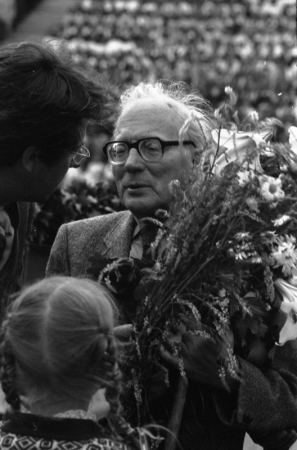
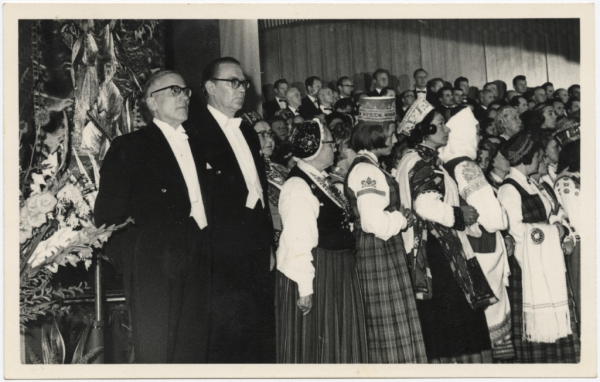
Pavasars was the chief conductor at the Song Day in Lübeck, Germany, in 1948 and at three English Latvian Song Days - in Leicester in 1958 and 1967 and in Bradford in 1961 – as well as at the First European Latvian Song Festival in Hamburg (1964). His instrumental works, choral songs and cantatas for special occasions were in the programmes of these song festivals. When Latvia regained its independence in 1990, Pavasars took part in the XX Latvian Song Festival in Riga.
In 1983, he received the PBLA People’s Award for his service to Latvian music. In 1990, he received the title of Honorary Professor of the Latvian Academy of Music. Pavasars’ contribution to music is about 80 choral songs, 4 cantatas, about 40 solo songs, 2 string quartets, a concertino for violin and piano, and a concerto for violin and orchestra (1964).
Information sources
Helmers Pavasars. (b.g.). https://www.lmic.lv/lv/komponisti/helmers-pavasars-319#work
Muižniece, M. (1982, 1. janvāris). Komponista Helmera Pavasara dzīves stāsts. Latvju Mūzika, 13, 1201.–1213. Latvju Mūzika, Nr.13 (01.01.1982) (periodika.lv)
Purvs, A. (1998, 19. septembris). Komponists Helmers Pavasars aizmūžos 19.V 1903–12. VI 1998. Latvija Amerikā, 37, 3., 7. Latvija Amerikā, Nr.37 (19.09.1998) (periodika.lv)